Hello...

Welcome to the Kirklees Wargames Club blog and forum. We are a small group of table-top wargamers who get together weekly to play games which vary from Ancient/Medieval, through English Civil War, American War of Independence, American Civil War, and all things Napoleonic, plus WW2 to Sci-fi and fantasy, using scale-model armies on purpose-built terrain and scenery. We meet at Beaumont Park Visitors Centre, Beaumont Park Road, Huddersfield HD4 7AY on Monday evenings from 6.15pm. New members (over 18) are always welcome. You can just drop in or contact us on: kirkleeswargamesclub@gmail.com. Facebook: Kirklees Wargames Club and Twitter: @KirkleesWC
Showing posts with label Medieval. Show all posts

Sunday, 29 October 2023

Wars of the Roses Club Demo Game at Fiasco 2023

 A successful War of the Roses club demo game put on at Fiasco 2023 at the Royal Armouries in Leeds. Congratulations to all those involved in managing the project, supplying and painting units, and building the terrain. Fingers crossed for a new club member (or two).


Wednesday, 29 March 2023

Completion of WOTR Bow and Bill unit

 Both bow and bill figures are completed, should have the artillery stand done shortly.


Wednesday, 9 March 2022

***STOP PRESS*** Japanese Samurai repulse Chinese & Korean invasion 1465 AD

 The year is 1465 AD and the Chinese with their Korean ally decide to invade Japan.

The Chinese intelligence and scouting must have been faulty, as they sent an almost totally mounted force into the hilly Japanese lowlands..

The samurai defenders were luckily able to deploy between 'difficult' hills, and with sporadic woods to their front, placing a large command of Ikko Ikki warrior monks (Hd S) in the centre, and trusty samurai foot (Bd O) on both flanks, expecting the Chinese force to try and outflank them.

As expected, the Chinese manouevered quickly to get their cavalry forces onto the flanks, found that the difficult hills had been reinforced with Japanese psiloi and ashigaru (Pk F) and so turned away, preferring eventually to charge head-on into the Japanese samurai flank commands.

The first cavalry force to hit home was the Korean ally left wing, but over two turns it became obvious the attack would fail as the samurai killed three bases of Cav O, with more to come had it continued.

The Chinese left flank was just about to charge home when the game ended, and the large and higher grade Chinese cavalry command never saw action.

The game ended with the Chinese invasion being repulsed and a victory to the Samurai.

Chinese were Norman and Nathan, Japanese were Guy and Tom. 


Tuesday, 25 February 2020

Historical Fiction #1: Grunwald 1410

In a change from the normal battle reports and pics, here's a bit of light reading from Ian F White...


Being a brief fictional account of the Battle of Grunwald 1410AD by John Blackwood, English Mercenary Captain of Cavalry (1386-1442).

The place of station allocated to our squadron of five and two score armoured horsemen afforded us an un-obscured vista over the land to our front and left. The ground sloped gently down from our position, and then rolled in undulating fashion for some one and one-half miles to where a thin tree line began. Thin at first then gradually thickening into a sizeable forest common to this region of Poland. The land was cut and carved by numerous streams and rivulets of little import, though they did help to drain the area into a marshland vale to the furthest left side of the woodland.
Many and varied were the colourful banners of our foe, which could be seen within and immediately without the tree line; many representing eagles and other birds of prey, in white, gold, red and black. Their number in the main being the banners of Lithuanian knights on this side of the field, though I espied the pennants of Tartars, Russians, Moldavians and even Hungarians among their assemblage.
My men and I had arrived only three days previously, having completed a contract in Milan the month before. Therefore our initial deployment was not as favorable as I would have hoped. However, during the maneuverings and posturing of the early morning, we soon found ourselves arrayed not overly far from the commanders of the Teutonic left flank – in particular Grand Marshal Frederick von Wallenrode himself.
At one point he did happen to glance over upon our position. I saluted him, but he merely curled his lip and rode away towards his command tents located close to the nearby village of Grunwald. I passed no comment; what could one expect, he was a Ritterbruder, a knight of God… and a German.
It had been a bright, cloud-free and extremely hot morning, quite a difference from the eight-hour march in driving rain we endured the day before. Now many of the knights around us had afforded themselves some relief from the heat - however briefly - through removal of their helms. The colour of their sweat drenched faces and frustrated expressions gave testament to their suffering; even though they were strong, hardy men, veteran campaigners who wore chain armour in favour of the plate - as was still preferred by the Poles and most other European knights of this region.
My men were impatient to be at the enemy and a general murmur of dissent in many tongues could be heard. Tempers were beginning to fray within the ranks, due to the tales that had reached us of the burning of Dabrowno and the butchery of all the German settlers therein. The Teutonic commanders, in particular Grand Master Ulrich von Jungingen, kept the troops under control and at about mid-morning the Grand Master sent a handful of his knights to tempt the Polish commanders out of their hiding places in the woods, and onto the open field. The ‘gift’ of two swords was apparently treated with amusement by King Wladislaw Jagiello and fury by Grand Duke Vytautas.
But the ploy to spur the enemy forward with insults and jibes did not have its desired effect. It seemed to me that the Allied leaders - the old Polish King – now in his sixtieth year - and the much younger Grand Duke of Lithuania – had the upper hand in the battle of wills. I heard tell later that the king was at mass while we roasted in the morning sun. Men fight for many reasons – God, King, country, and family. I fight for money.
We were brought suddenly to attention by the thunder of the Teutonic cannons positioned both below our position and further to the centre of the field. Unfortunately the hellish clamour belied their almost complete ineffectiveness. Other than the first volley, I only heard three or four sporadic explosions over the next hour. It was the Lithuanians in fact who had attacked our thinly spread infantry, which although much more well armed, armoured and trained than the enemy militia foot soldiers, soon became hard pressed. However, the Grand Master did not release the knights for their relief.
The Infantry flexed then broke under the onslaught of the much more maneuverable Lithuanian lance- and bow-armed cavalry. At last a messenger arrived with orders for Wallenrode to counter-attack, and we were eventually able to enter the battle, charging down close behind nearly a dozen squadrons of Teutonic horsemen.
But it was too late for the infantry and it was ill-fate that some of them fled into the path of our charge. Many spearmen and crossbowmen fell, and were trampled under the hooves of our horses. Some men of my own company were unhorsed in the confusion. Indeed, my own animal fell and broke a leg, but I was fortunate to be unharmed and quickly located a remount.
I could see already that things had changed in our favour. Our heavy cavalry tore through the lighter enemy, killing many and scattering even more. A large group of Lithuanian and Tartar horse archers broke from the melee and headed for a clear area beyond the wetland. Marshalling my men, I gave chase. Some of the Teutonic horsemen followed us, eager for slaughter. And slaughter there was.
Eventually, messengers sought us out at our gruesome task and told of how the battle was progressing. Our enemies were more numerous and fresher due to their shaded position in the woods. Victory was in the balance, it seemed only a matter of a few hours before the battle would be ended – one way or the other. We were to return with the greatest urgency to relieve the left flank.
Horses blown and panting hard, we returned to the fight in time to witness the climax of the battle! The Teutonic army was in retreat, Polish knights were everywhere, it seemed. Peasants with spear and bow swarmed from the forest to add insults to the injuries, cursing their hated ‘Krzyzacy’.
Alas, in spite of his many bodyguards, Von Jungingen was cut down by tenacious Czech nobles - dead before he hit the ground from many fatal blows; the worst being a spear-thrust through his throat. It was over… especially when the flighty Lithuanians and Tartars we had been chasing returned to harry our flanks and rear.
The surviving Teutonic Knights hastily retreated from the field, to regroup at their castle at Malbork which they expected Jagiello would soon assault.
Achieving terms for surrender with a high-ranking Polish knight who gave his name as Zawiszka, I and my diminished company began the return journey to England upon the very next day.

The End

Wednesday, 2 February 2011

Middle Plantagenet English - Part 3

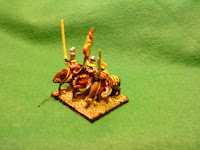
Here's King Edward II and his gay entourage (allegedly).
Yes, I painted the lions on the flag and shield myself - they look okay at a distance.!

Sunday, 16 January 2011

Middle Plantagenet English - part 2

Here are the slightly blurred pics of the 2x 6-base Welsh Archer batle Groups and an even fuzzier Field Commander Gilbert de Claire.


Friday, 14 January 2011

Middle Plantagenet English

I am starting yet another painting project. This time, it’s a 15mm Middle Plantagenet English Starter Army for use with Field Of Glory against Paul’s Scots in our future demo game of Bannockburn.

My figures are from Essex Miniatures and comprise the following:
1x C-in-C base: Edward II
1x General: Gilbert de Claire
1x General: Humphrey de Bohun
1x 2-base Unit of Royal Household Knights
3x 4-base Units of Feudal Knights
1x 8-base Unit of Spearmen
2x 6-base Units of English Longbowmen
2x 6-base Units of Welsh Longbowmen

I got them for Christmas and have thus far painted 1x 6-base Unit of Welsh Longbowmen
Cheers,
Ian

Wednesday, 3 February 2010

Polish v Hungarian 1st Feb 2010

Field of Glory Later Polish v Mid Hungarian 900 pts 1st Feb 2010

Outnumbered and hampered from the start by cultivated fields, the Poles nevertheless advanced on a wide front (which ultimately proved their downfall.


Their knights on the left flank never got to their intended targets, being hassled by horse archers and then routed by a timely flank charge which heralded the end of the game. The town militia on the right, Supported by cavalry and hussars, held out for longer that expected as enemy light horse managed to get around their rear.


Interesting game; some amusing incidents hither and thither, but on the whole not really a game I fancy playing on a regular basis.


Once again, sorry about the poor quality of the photos.

Words by Ian
Photos by Ian

Wednesday, 20 January 2010

DBMM Battle: Samurai v Timurid 18-01-2010


Samari v Timurid

The report of the following wargame took place on the 18th January 2010, using DBMM rules, 350 points per army and 15mm figures.

After initial Agression and deployment dicing Timur became the invader and after early morning maneoveuring the battle commenced at 11 am ish

The Timurids deployed their mounted forces in two main wings left and right with a weak centre.

The Samari deployed their Horde in front of their central foot command and then two further right and left wing commands of mixed mounted and foot.

As the Samari advanced the Timurid left wing moved further out, and the central command move to the rear of the right wing command. (as per IW's picture)

Combat commenced on the Timurid Right wing with the Stampeding Camels and Elephants have some initial success, however the wyle Samari soon managed to surround both foes and destroyed them. Timur then tried without much success to punch a hole through the Samari's left and central wings but the valiant Samari poured men in from both commands blocking the attempt.

Over on the Timurid Left both forces stood off each other as the Samari had the advantage of the upground and the right wing protected by a wooded area.
Eventually the Timurids charged uphill into the affray which see-sawed up and down as each side battled hard to maintain\ gain any advantage.

In the end actual time caused the game to be drawn to a conclusion after toting up the morale points lost it was agreed to call this a drawn game.

Report by Robin
Photo by Ian (apologies for poor quality)

Tuesday, 21 April 2009

Fuedal French v Fuedal Spanish

This was the second encounter between the Fuedal French (Robin) and Spanish (Ian) forces this time the spanish were led by El Cid ( a brillant general) played using the DBMM rules set

The Spanish won the agression dice choosing a river, Road, gentle hill (1/2 Fe) and vineyard. The French choose a road, 2FE steep hill, wood and Built up area. The River did not materialise as Ian rolled a 1 & 5. the reat of the features were placed as showen on the fiollowing map along with the initial placings of the commands.
The French first commands consisted of 7 Irregular knights Fast including CinC 4 Irr bow Inferior 2 Irr spear I 4 Irr Psiloi and a Regular artillery Ordinary bolt shooter. The second command consisted of 7 Irr knights F including general, 8 irr Spear I, 2 Irr bow I.

The Spanish first command consisted of El Cid Irr knight F, 7 Irr Psiloi O, 16 Irr Psiloi I, 4 Irr Bow I, 11 Irr Spear I, 2 Irr Blade O, and the cross Bagage Superior. the second command was 7 Irr knights F including general, and 4 Irr cavalry


As the French won the deployment dicing they deployed and moved first. Opening with a 6 knights of the 1st command forming a column of march and making a double move down the road also moving the bolt shooter and archers forward the second command wheel his knights on the right wing to ready his charge towards the Spanish 2nd command.

The Spanish replied by sending the knights of their 2nd command in a column of march down the road to meet the French resulting in the front elements in combat. The French open fire with their bolt shooter at the knight to no effect. But the resulting melee pushed back the Spanish knights.


The French knights expanded their column in the next bound to creat an overlap and brought their other knights forward with a double move to threaten the Spanish flank. After an ineffective round of combats. The Spanish used a brilliant stroke to double their pip points of their first command resulting in a general advance but not sufficient to bring their bows into range. the knights expanded their frontage on either side and their second rank of cavalry advanced to meet the threat of the French knights charging past the woods.
The following French 3rd bound was poor in terms of PIPa but saw the French CinC move into a position to meet the threat of the Spanish Foot along with the advance of 2 spear of the first command. The Knights of the 2nd command went into forward towards the Spanish Cavalry who had halted just out of range. However at this point the French caught sight of the Spanish Ambush behind the hill. This third command consisted of 4 Irr KN F including general and 3 Irr Light Horse O . No Missile fire took place as the their line of site was blocked by the abvancing knights of the second French command. The ensueing combats resulted in various push back on each side. The Spanish PIPs but enough to make 3 march moves with their third command and move some other units into a more threatening position. Again shooting was ineffective or unsighted the French won a melee or two.


Bound four saw the arrival of a French flank march on their left flank the movement of the art and bow towords the the Knights of the second command going into the Spanish 2nd command cavalry. The resulting combats causing losses on the Spanish side. The Spanish moved their 3rd command into a position to block the hole arising from the loss of their cavalry.
Bound 5 saw the arrival of a second French flank march this time on their right. The French moved Spear and bow from both commands to further counter the threat of the Spanish 1st command taking up positions along the road facing hill 1. The melee between the French Knights and the Spanish Cavalry resulted in them being destroyed. The see-sawing melee between the other knights saw an element loss on either side wiped them out causing that command to becoming dishearted. The spear of both the French commands took up postions to counter the Spanish foot.


So with the incoming French flank marches and the loss of the Spanish 2nd command and time as usual passing fast we agreed that the French had sucessfully ousted the Spanish invaders.

Friday, 13 March 2009

DBMM100 Mini-Tourney - The Armies

Fought between Ian and Robin on Friday 13th March 2009.
The armies involved were:

IV/42 Islamic Persian: 1x C-in-C Irr Cv (S), 9x Persian Cavalry Irr Cv (O), 2x Turcoman Irr LH (S), 8x Persian Archers Irr Bw (I), 1x Camp Followers Irr Hd (O) and 2x Camps Irr Bg (I).

IV/66 Later Polish: 1x C-in-C Irr Kn (O), 3x Rycerz Irr Kn (O), 4x Czeladz Irr Cv (O), 2x Axemen Irr Bd (F), 4x Town Militia Crossbows Reg Bw (O), 3x Lithuanian Cavalry Irr LH (O) and 1x Camp Irr Bg (O).

IV/74 Free Company: 1x English C-in-C Irr Kn (S), 4x English Gentlemen Reg Kn (I), 4x English Longbowmen Reg Bw (S), 3x Breton Javelinmen Irr Ps (S) and 2x Camps Irr Bg (O).

IV/75 Timurid: 1x C-in-C Reg Cv (S), 3x Timurid Cavalry Reg Cv (S), 4x Timurid Cavalry Reg Cv (O), 4x Timurid Archers Reg Bw (O), 4x Persian Militia Irr Bw (I) and 1x Camp Irr Bg (I).

DBMM100 Mini-Tourney - 1st Semi

Semi-Final #1… Timurid (7) played by Ian vs. Later Polish (3) played by Robin. Fought in Poland; 3x woods.
The Timurid archers pressed strongly down their left flank and slew all in their path while the centre and right held position under a concentrated bow and Light horse attacks. The game ended before the Polish Knights struck a blow.
Lesson learnt: Get the Knights into combat against Cv as soon as possible.
Timurid Set Up:

Later Polish Set Up:

The Final Positions:

DBMM100 Mini-Tourney - 2nd Semi

Semi-Final #2… Islamic Persian (3) played by Ian vs. Free Company (7) played by Robin. Fought in Persia; 1x gentle hill and 1x rough going.
The Free Company charged their knights into the massed Persian bow with disastrous effect. Meanwhile the stalwart and skilful English Longbowmen took care of many Persian cavalry. Things were looking well for the Persians until the English C-in-C carved his way through a column of cavalry to force hard a bloody victory.
Lesson learnt: Don’t charge mounted into archers (especially not Bw (S) ).
Islamic Persian Set Up:

Free Company Set Up:

The Final positions:

DBMM100 Mini-Tourney - Final

Final… Free Company (9) played by Ian vs. Timurid (1) played by Robin. Fought in Turkey; 2x steep hills.
A tale of woe for Timur’s Inferior bow as they fell and ran to the accurate longbows of the Free Company. His cavalry were caught in the open and chased down by the ‘Gentlemen’. As dusk fell the few survivors drifted away.
Lesson learnt: None really… when Lady Luck deserts you, there isn’t a thing you can do about it.!
Free Company Set Up:

Timurid Set Up:

The Final positions:

All in all a pretty good four hours of DBMM100 goodness…

Friday, 9 January 2009

Nicopolis at Recon 2006

The Wallachains...


Wallachians versus Turks with Serbs just arriving...


The Ottoman Turks on top of their hill...


French versus Turks...


French emerge from the woods...


View of the battle from above the Turks camp...